Easter is already next Sunday! Will you be doing anything special to celebrate?
Last year, I shared an eggsperiment my daughters and I tried that causes eggs to rise in water. I thought it was a great Easter project because it reminded me of Jesus rising from the dead. Great Bible lesson and science lesson rolled into one!
My daughters and I also enjoyed making these beautiful paintings and decorated eggs.
We also created these tape resist crosses while we had the paints out.
(This post contains affiliate links, which means I may make a small commission at no extra charge to you if you click on a link and make a purchase. The only way I get compensated for this post is through these affiliate links, so any purchase you make is greatly appreciated. Thank you!)
My daughters and I have enjoyed going on many field trips over the years. We’ve had the opportunity to take a “behind-the-scenes” tour of two post offices, a few stores, a police station, a fire station, an apple orchard, multiple farms, a sawmill, a fish hatchery, a radio station, a couple of recycling centers, and more. There truly are so many interesting places to explore!
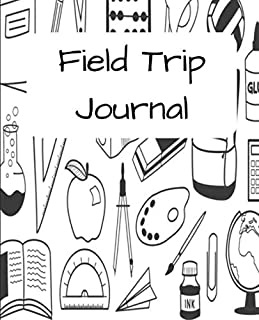
I even created a field trip journal earlier this year to record all of our field trip adventures. (You can get your own copy of this field trip journal here if you would like.)
My daughters had the chance to fill out their first field trip journal entry after we toured an airport in February. Unfortunately, other planned field trips have been cancelled as a result of COVID-19.
So, does that mean we can’t take any field trips at this time? No! Thanks to technology, there are a lot of opportunities to take virtual field trips. No dress code, no preplanning, no commute, and no fee required!
“Visit” zoos, aquariums, observatories, museums, food factories, and more from the comfort of your home with these webcams, virtual tours, and videos.
This is a long list of virtual field trip opportunities. I would not recommend doing them all at once. You don’t want a field trip burn out! Choose the ones you are the most interested in and do them as time and patience allow. It’s okay to bookmark this page to come back to for future field trips. That’s what I plan to do! With that being said, some of these virtual field trip opportunities have been created within the last few weeks in response to COVID-19, and I don’t know if they will remain after the quarantines have ended. You may want to do those field trip opportunities first if you are interested in them just in case.
(As a side note, I can’t control what others put on their websites, so please use with caution. I have clicked through many of the links to make sure they work, but I don’t have the time to explore all of them completely. Some of these links I have included are links to YouTube videos.)
Zoos
My family has had the opportunity to visit the Minnesota Zoo, Milwaukee Zoo, Racine Zoo, Madison Zoo, and (my personal favorite) Omaha Zoo. If you are unable to visit a zoo in person, watching the various zoo animal cams may be the next best option.
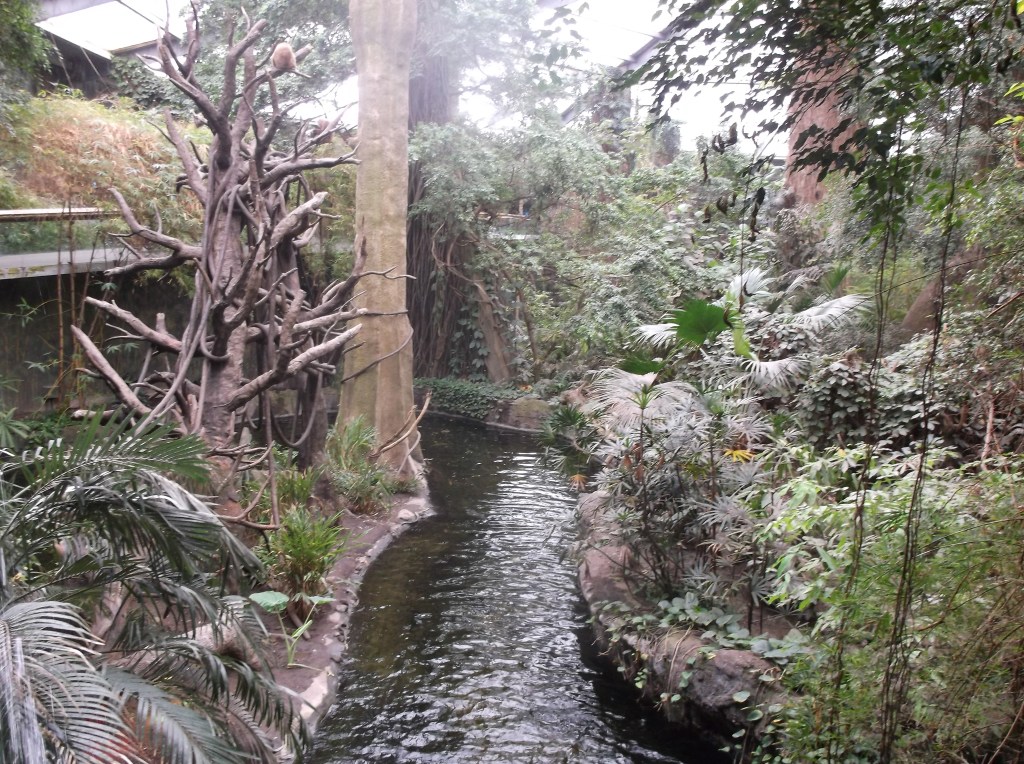
In the Lied Jungle Building at Omaha Zoo (photo taken by Brigitte Brulz)
As the title suggests, this website offers links to zoo cameras all around the world. The list of zoos with webcams page includes the Alaska Zoo, Baton Rouge Zoo, Blank Park Zoo, Chattanooga Zoo, Chester Zoo, Cheyenne Mountain Zoo, Columbus Zoo, Cotswood Wildlife Park & Gardens, Dublin Zoo, Edinburg Zoo, El Paso Zoo, Greenville Zoo, Healesville Sanctuary, Highland Wildlife Park, Houston Zoo, Indianapolis Zoo, Kansas City Zoo, Marwell Zoo, Melbourne Zoo, Metro Richmond Zoo, Milwaukee County Zoo and Zoological Society, Minnesota Zoo, Monterey Bay Aquarium, North American Bear Center, Red Park Zoo, San Diego Zoo, St. Louis Zoo, Tallinn Zoo, Tennessee Aquarium, The National Zoological Park, Toledo Zoo, Tulsa Zoo, Virginia Zoo, Werribee Open Range Zoo, Woodland Park Zoo, Zoo Atlanta, Zoo Sauvage, and Zoo Montana. The live zoo cameras page offers a long list of animals to watch via webcams.
Some of the links may not direct you to an exact webcam, but many of them still offer information about the zoos. For example, when I clicked on the “Ant Webcam,” a page about the Marwell Zoo Webcams with interesting facts about the Marwell Zoo appeared. At the bottom of the page, I clicked on “view the Marwell Zoo webcams,” which opened a new tab with links to the webcams Marwell Zoo currently offers. These include a flamingo, lemur, giraffe, and penguin webcam, so I didn’t find the ant webcam I had originally clicked on. I guess that is kind of like actually going to visit a zoo when you expect to see a certain animal but that animal’s exhibit has been closed for some reason.
Ants (photo taken by Brigitte Brulz while visiting a nature center)
The Cincinnati Zoo is currently sharing information about their animals through a Home Safari Facebook Live each day at 3pm EDT. If you are like me and don’t have a Facebook account (or are unable to watch the presentations live), you can watch all of the videos on their YouTube channel.
The Omaha Zoo is offering daily interactive videos and activities to do at home during this time. Some animals they currently have information for include rhinos, frogs, sloth bears, chinchillas, red pandas, sea lions, rattlesnakes, goats, bongos, and aye-ayes.
Learn about more than 100 animals you may find at the zoo with this zoo guide written with a Biblical perspective from Answers in Genesis. This is a great resource for animal-loving kids and your next zoo visit, whether virtual or in-person.
I had a daughter who went through a phase years ago where she wanted to learn all about animals. This book was a great curriculum option for that time. We learned a lot about flying creatures!
We also learned a lot about land creatures with this Apologia book around that same time.
More Animal Cams
You might be able to see birds live through your own windows! As I write this, I can see a robin in the grass and two birds on my deck. But if you are looking for more choices of watching birds and other animals around the world, you may be interested in these options.
This website links to multiple other animal cams around the world. I spent quite a bit of time watching the meerkat cam from Miami, Florida. The meerkats were very active and so adorable!
If you like watching birds, this is the website for you. They offer links to live cams of multiple bird feeder locations and specific birds such as owls, red tailed hawks, Bermuda petrals, northern royal albatrosses, and more.
This is a live feed of a bald eagle family in Decorah, Iowa near a fish hatchery that my family has had the opportunity to visit.
Aquariums
My family has had the pleasure of visiting the Georgia Aquarium, Sea Life Minnesota Aquarium, Clearwater Marine Aquarium, Reiman Aquarium, and other aquariums. Something about watching the fish and sea creatures swim around is mesmerizing!
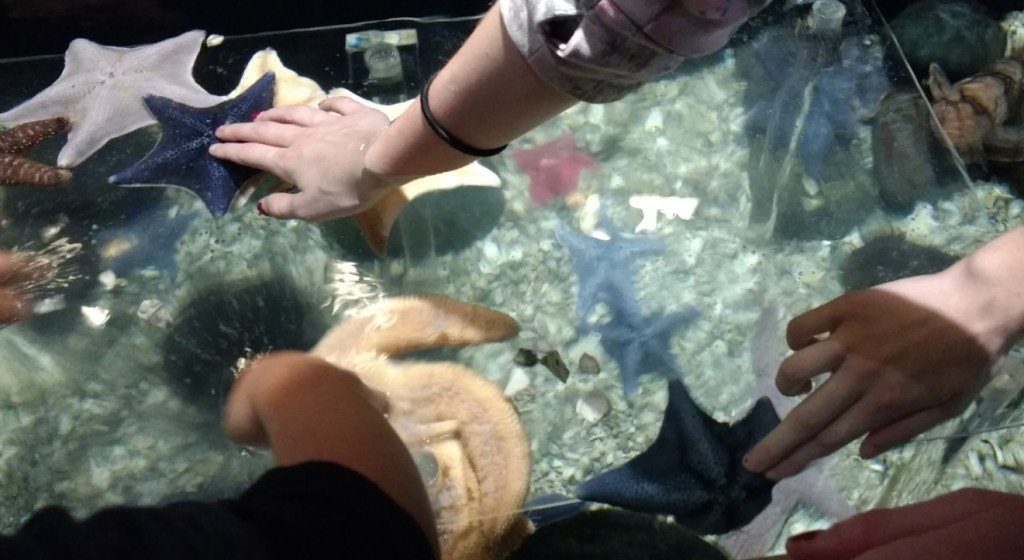
Going to an aquarium provides so many wonderful experiences. We have touched jellyfish, horseshoe crabs, stingrays, sharks, sea anemones, sea urchins, and sea stars. We have watched sharks, penguins, and stingrays being fed. We have seen Winter and Hope (the dolphins from the Dolphin Tale movies) in person, and we have been awed by the size of the sea creatures as they swim over our heads. Isn’t God such an amazing designer?
Unfortunately, traveling to an aquarium is not always feasible (especially at this time). So, here are some aquarium cams and at-home resources to check out at various aquariums in the United States.
Touching Sea Stars at the Omaha Zoo and Aquarium (photo taken by Brigitte Brulz)
Watch the penguins above and below the water, the creatures of Shark Lagoon and the Tropical Reef, sea jellies, and other fish on the webcams at the Aquarium of the Pacific.
The Georgia Aquarium is offering quite a bit of at-home educational resources. Check out their website for videos, facts, webcams, lesson plans, teacher resources, and more. They are also currently accepting artwork from kids and have a gallery of some artwork that has been submitted to them.
This website offers links to various aquarium webcams. Listed aquariums include the Blank Park Zoo Aquarium, Aquarium of Pacific, Monterey Bay Aquarium, and National Aquarium Baltimore.
Of course, we couldn’t learn about land animals and flying creatures without learning about swimming creatures, too. This is another Apologia book my daughters and I completed years ago.
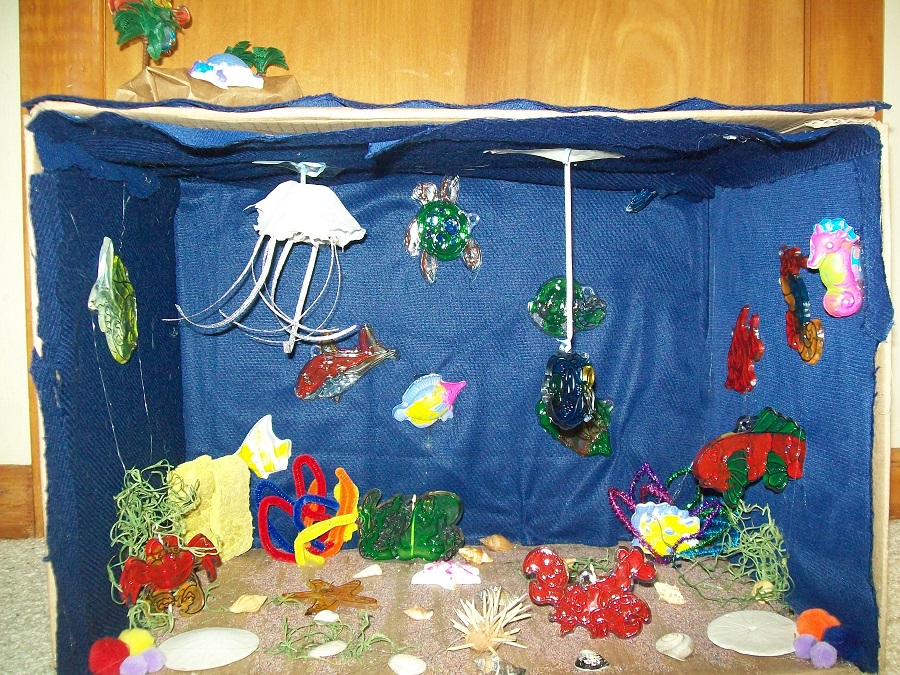
There are quite a few hands-on activities to do along with the Apologia books. Below is a picture of an underwater-themed diorama we created as an idea from this book.
Our Underwater Diorama (photo taken by Brigitte Brulz)
Planetariums and Observatories
My family has had the opportunity to visit a few planetariums together, and I have had the chance to visit the Adler Planetarium in Chicago. We’ve also taken part in an event at a nature center where we looked through telescopes, went into a portable planetarium, and learned about space. I don’t remember ever visiting an observatory, though.
Years ago I wrote a story about a boy who insists, “I’m a big kid now, and I can count really high, so let’s try to count all the stars in the sky.” The boy learns a lot about stars and the solar system while on a visit to a planetarium with his grandma, but he discovers there really are too many stars in the sky to count (even for adults). That story is still in a file of “unpublished works.” Looking into the night sky, whether in person or in a planetarium, is a reminder of Psalm 147:4.
Anyways, below are some planetariums and observatories you can virtually visit.
Our Homemade Constellations Chart (photo taken by Brigitte Brulz)
Learn more about the Hubble Space Telescope, Spitzer Space Telescope, International Space Station, and more through the virtual tours and apps available on NASA at Home.
This is another Apologia book my daughters and I have completed together.
Museums
Children’s museums, art museums, natural history museums, living history museums, city museums, and more. There are so many different types and sizes of museums to visit. I think the living history museums are my favorite!
From the 1700 Ioway Farm at the Living History Farms in Urbandale, IA (photo taken by Brigitte Brulz)
My daughters have had fun at the Madison Children’s Museum, Milwaukee Children’s Museum, and the Children’s Museum of La Crosse. I really think children’s museums are more fun to explore in person, but the Boston Children’s Museum does offer you a glimpse of their museum through their virtual tour.
I am the only one in my family who has actually had a chance to visit the Louvre in person and that was over fifteen years ago. I’m pretty sure we will not be taking any family trips to France, so this virtual tour of the Louvre will have to suffice.
Learn all about Ellis Island through the stories of some immigrants who stopped in Ellis Island, photos, facts, and more on this interactive tour of Ellis Island brought to you by Scholastic.
This offers only three views of the Henry Ford Museum (at the bottom of the page), but it does have a lot of pictures to look through. If you are wanting even more resources for The Henry Ford, make sure to check out their Digital Collections, their Virtual Visit, and even more things to explore.
My family has had the opportunity to explore quite a few caves, but none of them come even close in size to the Son Doong Cave. Explore the world’s largest natural cave located in Vietnam virtually from your home through National Geographic’s website. Many interesting facts are provided as you journey through the cave. (As a side note, it does state the cave was formed “over the course of hundreds of thousands of years.”)
Videos and teacher guides are available to learn about rain forests, deserts, coral reefs, renewable energy, and more. Curriculum is also available to download on the Nature Conservancy’s website.
Visit Orlando offers virtual tours of the things you can see and do in Orlando including Sea World Orlando, Walt Disney World Resort, and Universal Orlando Resort. All places I have never visited!
These FarmFood 360 videos are really neat! Not only can you watch a video tour of an egg farm, sheep farm, pig farm, cheese processing center, grain farm, apple orchard and more, but you can also move the video screen around to see a full view of the area. Hence the name 360 (for the 360 degree view). FarmFood 360 also has a website you can view here if interested.
SchoolhouseTeachers.com is an online homeschool curriculum site with over 425 courses and resources for all ages at one low price for the entire family. My daughters have used SchoolhouseTeachers.com for quite a few of their own school subjects, which I hope to write more about in future posts. SchoolhouseTeachers.com membership also includes a subscription to The Old Schoolhouse Magazine, RightNow Media videos, course certificates, and much more.
SchoolhouseTeachers.com does not have virtual field trips directly on their website, but the course I created last year called Foods and Food Production does provide links to some video tours.
The Foods and Food Production course includes 154 pages of information about 26 different foods and how they are grown, harvested, processed, and used. I included opening and closing questions, links to videos, book lists, interesting facts, geography information about where each food is grown with a flag matching worksheet, information about what the products can be used in, and recipes for each of the 26 foods.
Of course, I won’t be listing all of that here, but the following food tour links are some of the links found within that course. My daughters and I watched all of these videos (and more) while I was creating the course.
Foods and Food Production Course from SchoolhouseTeachers.com
This is a very detailed video that shows the outside process of almonds as well as an inside tour of Blue Diamond factory. It has interviews of some employees of Blue Diamond, history of Blue Diamond, interesting questions and answers about almonds, and discusses the variety of foods almonds can be used in. Since the video was done by Blue Diamond, it does advertise Blue Diamond.
This video talks about the history of blueberries, differences of wild blueberries and cultivated blueberries, the stages of a blueberry as it ripens, how to pick blueberries by hand, the machine used to pick remaining blueberries, how blueberries are sorted and processed, and where blueberries may go once sorted.
This video shows how purple sprouting and broccoli crowns differ in harvesting techniques, the amount of broccoli picked, and how the broccoli is processed before reaching your local store.
This video talks about the history of one family-owned cherry farm, Allan Brothers Fruit. It shows how the cherries are handpicked, the different varieties of cherries, ways they keep birds away from the cherries, some information about a cherry farm, and how the cherries are processed in the packing plant. This company can process up to twenty-seven tons of cherries per hour according to the video!
This video gives an inside view of the Washington Fruit and Produce Co. factory and shows some machines used to check and process cherries for packaging.
The beginning of this video is a cartoon of ducks planting corn, but then it moves on to real pictures and discussion. It talks about sweet corn, field corn, and popcorn. It also shows the different parts of a corn plant including the roots, stalk, leaves, tassel, silk, ears, and kernels. It also shows how the corn grows with a video of roots forming underground, and it lists a number of items that can be made with corn such as candy bars, ethanol, bubble gum, soap, and more.
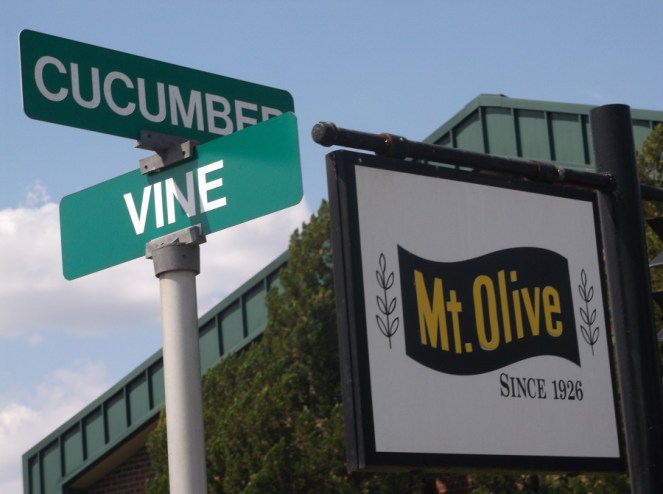
This video shows the processing of pickles at Mount Olive Pickle Company up until 9:35. After that, the video discusses Mount Olive Pickle Company’s recycling program, community service activities, yearly Pickle Festival, and New Year’s Eve pickle drop.
On the Corner of Cucumber and Vine at Mt. Olive Pickle Company (photo taken by Brigitte Brulz)
This video shows what happens to kiwifruit plants in preparation for growing season, harvesting of kiwifruits, how to wear the collection bag for harvesting, and the steps the kiwifruit goes through inside a processing center all the way until it is loaded in the back of a trailer by forklift. Text on the bottom of the screen labels each stage.
This video shows two different ways olives can be harvested and processed into oil. It also shows the olive oil being sampled and mentions why olive oil may be bottled in green glass jars.
This fast-paced video has no explanation, but is shows orange trees being planted, oranges being harvested, and oranges being processed to make orange juice.
Learn where oranges are sold with a green peel, how oranges grow, about different types of oranges, how oranges are harvested, and information about pests that affect the orange groves.
This video shows a peanut field being prepared, peanut plants growing, peanuts being harvested, and the process the peanuts go through once at a factory. A man narrates what is happening throughout the entire process.
This video shows how fields are prepared and how pineapples are grown at a farm in Costa Rica. It also demonstrates how each pineapple plant is planted and how each pineapple is picked, placed in bins upside down, checked, and processed in a factory.
This video shows the different stages of flowering, harvesting pineapples by hand, temperatures needed for proper tasting pineapples, how pineapples are planted, how to properly prepare fields for pineapples, and how the pineapple fields are maintained once planted. The video states that it takes 13-16 months per plant to produce a pineapple!
This video shows potatoes being planted, harvested, and processed in a factory for packaging. At one point, the video says that the fields are desiccated prior to harvesting, which is a word many kids (and possibly adults) may not know. Desiccated means to dry up, so it is saying the fields must be dry before they can harvest the potatoes.
This video shows how potatoes grow, what tubers are, and what turns some potatoes green. It also shares information about potato beetles and Ireland’s potato famine. Then, the potatoes are taken to a factory where they are peeled, sliced, fried, and prepared as chips.
This video shows tomato plants grown inside. It also shows how the tomato plants grow, how the tomatoes are harvested by hand, how they are transported inside by driverless mini tractors, and packaged at a packing plant.
I love watching videos of how things are made, so the How It’s Made YouTube Channel is a place I will definitely have to come back to again. It offers over 1,000 videos that are each about 5 minutes long on how various items are made. That’s over 1,000 short virtual field trips! My daughters and I recently watched the videos of how rubber bands, balloons, crayons, toothbrushes, and aluminum foil are made.
Blippi is a very energetic character! This YouTube channel provides video tours of quite a few places including a children’s museum and bakery for toddler and preschool age.
My daughters and I have had the opportunity to tour two different recycling centers. One was much larger than the other, so it was interesting to see the different aspects of each. This video field trip to a recycling center is available on the South Florida PBS channel and is intended for a younger audience. It has cartoons along with actual recycling center tour footage.
Bays at a Recycling Center for Trucks to Unload Recyclables (photo taken by Brigitte Brulz)
Years ago, my daughters and I toured a fire station with our homeschool group. The kids had a lot of fun trying to control the fire hose as water gushed out of it (with the help of others). This virtual video of the Memphis Fire Department is a great alternative if you can’t visit one in person.
My daughters and I toured a saw mill a few years ago with a couple of friends, which I found to be quite interesting. This video tours a saw mill beginning with trucks loaded with logs. It shows the process of the logs being unloaded and transformed into utility poles, cut boards, and more. The video was put together very well. The camera goes places (in the machines) that we obviously couldn’t go through in person. (There were a couple of commercials at one point during the video, which I was able to skip after a few seconds each.)
Watching Logs Being Processed at a Saw Mill (photo taken by Brigitte Brulz)
My daughters and I have had the opportunity to tour two different post offices, but we didn’t get to see the inside of any of the post office delivery trucks since they were delivering mail at the times of our tours. So, this video was a nice complement to our post office tours. It shows the inside of an LLV (Long Life Vehicle) including some of the gauges and gadgets. The man videotaping kept mentioning how old these vehicles are, which is something that was discussed on our most recent post office tour. Towards the end of the video, he unsuccessfully shows how to latch the seatbelt (probably because his one hand is preoccupied with holding the camera).
I love feeding the fish at fish hatcheries. The fish swarm to where the food is and splash all over (as seen in the photo below). The fish even follow you as you walk along their tanks as though they are waiting for you to feed them (at least on certain days). This video gives a tour of a fish hatchery starting with the delivery of fish eggs via FedEx. It goes through the process of taking care of the eggs and the fish as they mature. The fish hatchery shown in the video raised over 1 million trout in 2015!
Yes, this is another video of a fish hatchery, but different tours offer different perspectives of the industry. This video also goes through the process of raising trout, but it doesn’t discuss the process of taking care of the eggs like the last video did. It also provides more information on the machines used to filter the water. The fish hatchery in this video raises 250,000-300,000 trout each year.
Feeding Fish at a Fish Hatchery (photo taken by Brigitte Brulz)
Even More Resources
Obviously, there are many other virtual field trip opportunities available.
Virtual School Activities currently offers additional links to webcams, virtual tours, and other educational sites that may not have been mentioned here.
Here is another link sent to me by St. Paul’s Girl Scouts Troop 30 with even more virtual field trip tours.
Thank you to Megan for finding these virtual COVID-19 friendly field trips around the world, which includes a large list of museums, zoos, aquariums, farms, space-themed places, historical sites and landmarks, and more that can be visited virtually!
Thank you to Kelly for finding this website with virtual zoology links, which includes links to cams for a lion, platypus, baboon, flamingo, panda, and more.
Don’t forget to visit fun extras for free coloring pages, activity ideas, and a teacher’s guide. Story Monsters at Home is also full of book downloads, activities, and videos of authors reading their books. Authors Everywhere is another resource to check out for book lovers. It is a YouTube channel filled with videos of authors reading their books, writing prompts, activities, and more.
I’m looking forward to being able to go on field trips in person again when we are able, but there are so many options here to explore with my daughters in the meantime. I definitely want to watch more of the FarmFood 360 videos and How It’s Made videos!
Please share this with others who may enjoy these virtual field trips!
(This page may contain affiliate links, which means I may make a small commission at no extra charge to you if you click on a link and make a purchase. As an Amazon Associate, SchoolhouseTeachers.com Affiliate, and Udemy Affiliate, I earn from qualifying purchases. I greatly appreciate all purchases you make using these links. Thank you!)
Authors who want to have a book traditionally published must submit their manuscripts to literary agents or publishers who accept unsolicited manuscripts. Unsolicited manuscripts are manuscripts that have not been requested.
Submitting manuscripts often leads to rejection. But not submitting any manuscripts guarantees no book deal with a traditional publisher.
Many literary agents prefer receiving manuscripts that have not already been sent to multiple publishers. On the other hand, having a publisher interested in a manuscript may help gain the attention of a literary agent. So, what is an author to do? Each author must make his or her own decision.
Keep reading if you are a children’s book author specifically looking for traditional publishers who accept unsolicited manuscripts. I have listed 37 traditional publishers who are currently accepting unsolicited manuscripts (at the time of this writing) along with the links to their submissions pages.
Even though these publishers accept unsolicited manuscripts, quite a few of them have separate links or instructions for agents to submit manuscripts. I’m guessing these publishers will take agented manuscripts more seriously than unagented manuscripts since the manuscripts have already been vetted by someone in the writing industry before being submitted to them. With that being said, please do not claim you have an agent for your manuscript if you don’t.
Please visit their websites (not just their submissions pages) before submitting to them to make sure they are still accepting unsolicited manuscripts, to see what style of books they publish and if your manuscript would be a good match, and to read their manuscript submission guidelines.
All of these publishing companies are kind enough to allow authors to submit unsolicited submissions. As a result, they may receive literally thousands of manuscripts each year. Please don’t waste their time (or your own time) by submitting manuscripts that do not fit their book lists. Make sure to properly format your manuscript, cover letter, and whatever else you are required to submit. Follow their submission guidelines exactly as stated.
Some of these publishers may respond within a specified time frame. Others will only respond if they are interested in publishing your manuscript. Please don’t continually pester them if you don’t hear back from them. Be patient and professional.
These are all publishing companies I have found on my own, but I have not had personal experience with them. Please do your own research to make sure they are reputable companies before submitting to them. You can do this by checking out books they have published and reading reviews of their companies online.
Traditional publishers will not charge authors any money to publish their books.
Currently seeking fiction and nonfiction picture book manuscripts, middle grade fiction submissions, and young adult fiction submissions. Accepts manuscripts by email.
Currently seeking books on “physical science, engineering, earth science, science or math manuscripts with a cultural/social studies connection, and manuscripts for Pre-K3 to kindergarten-age children.”
Won’t accept manuscripts in rhyme. Does not want books about pets, new babies, magic, fantasy, biographies, counting, ABCs, poetry, fairy tales, or holidays. Also does not want any book series.
“Currently interested in children books, foreign language learning books, business and financial advice books, parenting advice books, art instruction books, sports, fashion, crafts, and study guides.” Accepts queries by email.
Publishes children’s realistic fiction picture books with less than 1,000 words only. Accepts unsolicited submissions only at certain times of the year by email. (The submission window just closed on February 1st.)
Publishes a total of 12 to 18 books each year. These include “picture books, middle reader and young adult fiction and nonfiction.” Accepts submissions by mail.
Publishes fictional children’s picture books under 1,000 words in length with a universal theme dealing with family or social situations targeted to ages 4-8. Accepts submissions by email.
Seeking “manuscripts that reflect themes of diversity, inclusivity, compassion, care for each other, care for the world, social justice, and contemporary issues . . . appropriate for a general trade market and found in bookstores, libraries, and schools.”
Does not accept biographies, autobiographies, or religious content. Publishes early childhood board books and picture books on social skills and positive behavior. Accepts submissions through Submittable or by mail.
Interested in nonfiction and fiction submissions for picture books, chapter books, middle grade, and graphic novels for PreK-5th grade audience. Accepts submissions by email.
Accepts submissions for middle grade and young adult fiction. Welcomes “applications from authors interested in producing fiction manuscripts on a work-for-hire basis.” This is an imprint of North Star Editions. Accepts submissions by email.
Accepts picture book manuscripts under 1,000 words. Don’t like rhyming text. Seeking “fresh, original, fiction with universal themes that could appeal to children ages 3-8.” Accepts submissions by email.
Accepts resumes from experienced authors for work-for-hire on fiction and nonfiction projects intended for a middle grade and high school-aged audience.
Publishes fiction and nonfiction picture books, Early Reader fiction, nonfiction chapter books, fiction and nonfiction for middle grade, and young adult fiction and nonfiction. Accepts manuscripts by mail.
Publishes young adult fiction and nonfiction with a minimum of 25,000 words, juvenile fiction and nonfiction for ages 8-12 with a maximum of 25,000 words, and juvenile fiction and nonfiction picture books for ages 5-8 with a maximum of 1,100 words (plus author’s note). Genres include holidays, history, biography, African American, regional, and STEM depending on the age range. Accepts manuscripts by email.
Prefers author/illustrators. Seeking children’s books that “represent diverse characters, cultures, identities, and points of view” and “deal with contemporary topics.” Prefers submissions by email, but does allow submissions by mail.
Seeking “new projects that offer a fresh perspective or untold story in the sports realm.” This is an imprint of North Star Editions. Accepts submissions by email.
Publishes board books, picture books, early readers, and chapter books (fiction and nonfiction). Seeks to publish “books that are entertaining, meaningful and sensitive to the needs of all children.” Accepts submissions by mail.
Publishes picture books, board books, middle grade fiction, and young adult fiction under the Sterling Children’s Books imprint. Accepts submissions by mail.
States that part of their mission “is to publish writers whose voices haven’t been heard before.” Accepting picture book and graphic novel submissions by email.
Publishes nonfiction books for children and adults. Not accepting picture book submissions. Accepting submissions by email.
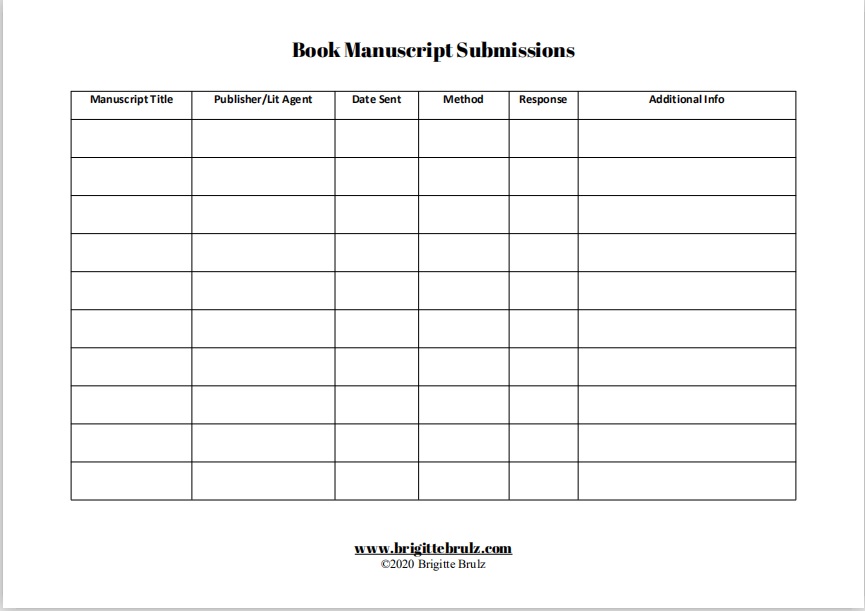
Whether you decide to submit to literary agents or directly to publishers, you should keep track of all your submissions. If you have your own way of doing this that works for you, great! I’d love to hear about it. If you don’t have any chart of your own, you are welcome to download the chart I use to track all of my submissions.
The chart is pretty self-explanatory. I write the title of the submitted manuscript in the column that says “Manuscript title,” the name of the publisher or the literary agent (along with the name of the agency the literary agent works at) under “Publisher/ Lit. Agent,” and the date I sent the submission under the “Date Sent” column. Under the “Method” column, I record whether I sent the submission by email, mail, Submittable, or some other online portal. I write the response (along with the date I receive the response) under the “Response” column. Any additional information such as how long it generally takes for them to respond if they do respond and what was submitted (if different than usual) gets written under the “Additional Info.” column.
I keep the chart in an easily accessible folder, so I can update it as needed. Color coding the book titles by putting a specific color dot (with a marker) next to the manuscript title (just to the left of the chart) makes it easier to find specific titles.
This is just what has worked for me up to this point. I’d love to hear what has worked best for you or if you know of any other children’s book publishers currently accepting unsolicited submissions in the comments section below.
If you would like to receive a monthly e-newsletter for all of the available freebies, journals, books, and more as they are added to my website, please join my email list.
Processing…
Success! You're on the list.
Whoops! There was an error and we couldn't process your subscription. Please reload the page and try again.
I’m still waiting for the Sermon Notes journal I created to be approved and published, which should be any day now as long as everything goes as planned. When I was giving a sneak peek to the Sermon Notes Journal, I mentioned I had a secret project I was working on. Well, here it is…
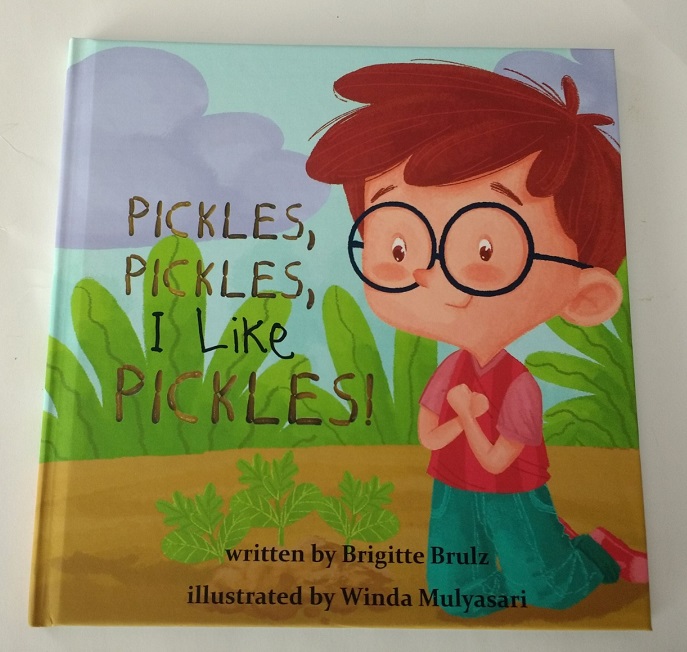
I was really excited to receive the hardcover version of Pickles, Pickles, I Like Pickles by mail today. Unfortunately, I noticed a couple of mistakes on the first page.
The comma is missing and the words are too close to the picture. I’m disappointed I had missed that, but I’m glad all of the other pages looked good.
I have corrected the mistakes and reuploaded the file. I’m hoping the updated version without the mistakes will be approved really soon because the original file with the mistakes is already available for sale on Amazon. Oops! I will let you know as soon as the updated version is available.
I’m really excited about having Pickles, Pickles, I Like Pickles as a hardcover book. Not only was the front cover updated, but the back cover was also updated.
And it is now thick enough to have a spine with writing.
Hardcover copies are more expensive than softcover copies, but they are generally more durable so kids can read them over and over again more times.
Free coloring pages, activity ideas, and a teacher’s guide to go along with Pickles, Pickles, I Like Pickles are still available under Fun Extras.
Do you think I should create a hardcover version of Jobs of a Preschooler? I’d love your thoughts!


























 Brigitte Brulz