Ramblings · Writing Appearances

Fall Leaves Activities

The first day of fall is only a few weeks away! It’s on September 23rd this year incase you were wondering.

With fall starting soon, my daughters and I will be creating a list of activities that we would like to do for the upcoming fall and winter seasons. I previously wrote about how we used ice cream scoops last year to show off our spring and summer activity wish list. My daughters and I enjoy creating these list of activities to do for the upcoming seasons twice a year (spring/summer and fall/winter).

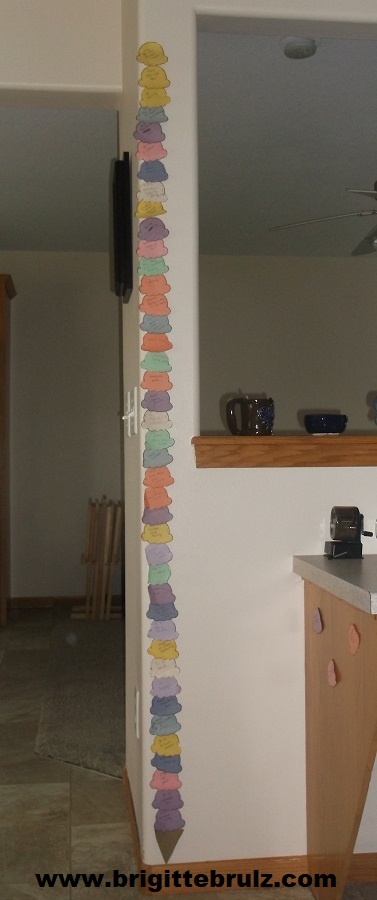
Here is our ice cream cone and scoops from last year for our spring/summer list:

display your spring and summer activities

Our ice cream scoops didn’t reach quite as high this year, but we still kept busy with a lot of projects and fun activities.

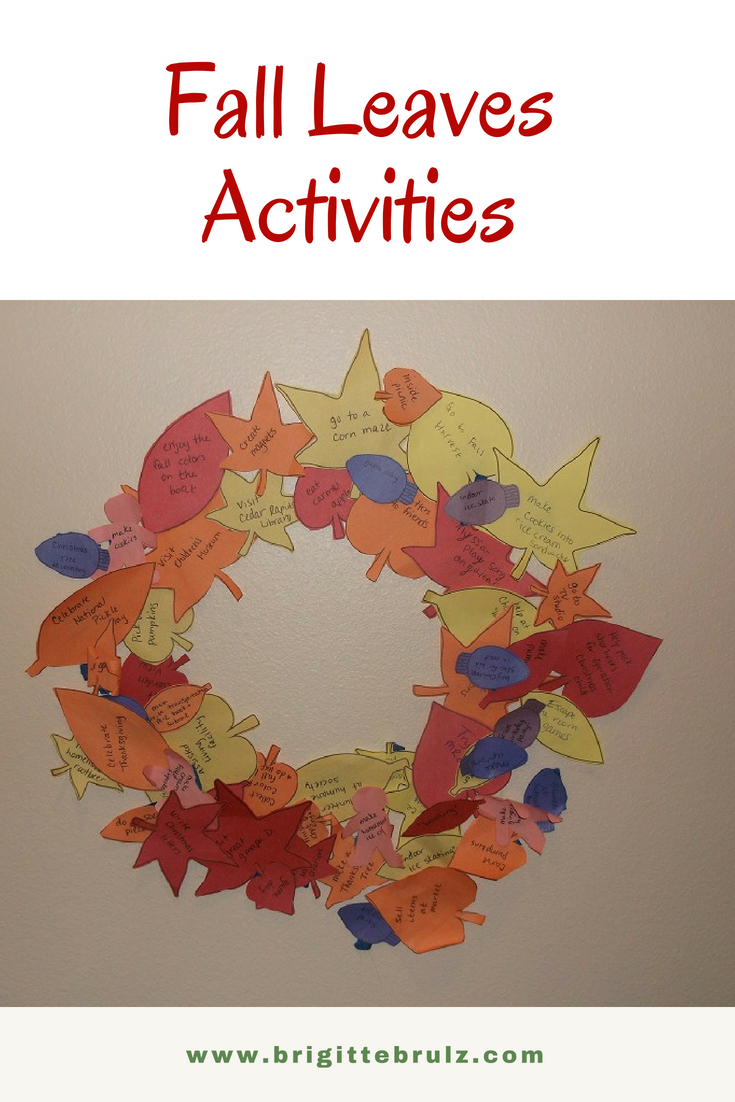
I love the beautiful colors of fall leaves, so last year we displayed our fall activities on autumn-colored leaves. I used a leaf printable (found on First Palette here) and printed the leaves on orange, yellow, and red construction paper.

Then, my daughters and I cut them out and wrote one activity on each leaf.

If you would like to do more projects using fall leaves as a theme, you may be interested in 50 fall leaf themed activities, books, crafts, and snacks, which I compiled and had recently published on Hands On As We Grow.

We used painter’s tape to tape all of the leaves on a wall in our house. As we completed each activity, we moved it to another wall to form a wreath. It took a while before we could tell it was a wreath, but the end result turned out cute.

Display your winter and fall activities!

Since we did the activities for fall and winter at the same time, I also printed lights (found on A to Z Teacher Stuff here) on purple and blue construction paper. Most of the light activities were activities we knew we could complete in winter. As we completed those activities, they were also added to our activity wreath.

It’s neat to go through all of the activities together at the end of the season and reminisce on what we have done together.

What is your favorite fall or winter activity?


Writing Appearances

Book Promoting

Last year, I published Jobs of a Preschooler and Pickles, Pickles, I Like Pickles (affiliate links). I had a lot of fun writing them and publishing them, and I learned a lot about the process of promoting them.

I always feel funny talking about myself or my books in person to other people, but I love having the opportunity to read my books to kids and listening to the stories of why someone is buying one of my books. (I hope to share some of those stories in a future post.)

To promote my books, I created this website, started a Pinterest account, created a Goodreads account, made coloring pages and activity sheets to go along with the books, celebrated National Pickle Day, was interviewed on live TV, led preschool story times, did a library presentation for adults, entered my books for a Goodreads giveaway, sold multiple copies of Pickles, Pickles, I Like Pickles to a couple of pickle stores, received a Readers’ Favorite 5 Stars Review for each book, and I signed up on HARO (Help A Reporter Out).

Jobs of a Preschooler is now Available!

I know there is more I could do to promote my books, but I haven’t done as much promotion this year for them as I did last year. Instead, I have been learning a lot by attending two SCBWI conferences, a picture book group meeting, and a monthly writer network/critique group meeting. I have also been writing quite a bit.

That doesn’t mean I have been doing no promotion for them, though. I am thankful both stores I sold multiple copies of Pickles, Pickles, I Like Pickles to last year contacted me again this year to purchase even more copies. I have also been selling copies of both books at a local farmers’ market, and I continue to add information to my Pinterest account.

Pickles, Pickles, I Like Pickles Available

I have also been responding to a few inquiries from HARO. Reporters, bloggers, and authors can use HARO to inquire about a specific topic. The “sources”, which I am signed up as, receive three e-mails a day five days a week. Each e-mail contains multiple inquiries. When I know I will have some time to respond to potential inquiries, I scan the e-mails to see if there is anything I would be able to respond to. Most of the time there isn’t anything I can answer; however, I have been used as a source on a few different websites, which have included links back to my own website.

Recently, I found an inquiry from AMA Feed on HARO asking for information about ways to promote a book. Thankfully, I had some time, so I responded with 14 potential tips. AMA Feed recently published what I had sent to them on their website. It has been published as 14 Tips to Promote Your Book.

Hopefully, I will continue to learn, write, and publish more books in the future that will need to be promoted.

What is something that turns you off from making a purchase?


Ramblings · Writing Appearances

At-Home Learning Activities

My daughters and I have enjoyed reading books and completing science experiments together this past summer. We do a lot of learning activities at home since we homeschool, but children who aren’t homeschooled can also have fun learning at home throughout the year.

I recently assembled a list of over 100+ fun learning activities for preschoolers and toddlers to do at home for Hands On As We Grow, which has now been published.

Even though I still do some activities with my daughters during the summer, I use our summer break as a time to sort through all of the curriculum I used with my daughters the previous school year, get rid of school items we no longer need, reorganize our school cupboard, decide what subjects and curriculum to use for the upcoming school year, purchase needed supplies and curriculum, print necessary paperwork, and come up with a schedule for at least the first few weeks of our upcoming school year.

I include my daughters in some of the decisions by creating a list of questions for them to answer at the end of the school year. Some questions include:

  • What did you like best about last year?
  • What didn’t you like about last year?
  • What would you like to learn more about?
  • What would you like to do the same as last year?
  • What would you like to do differently?
  • What is your favorite subject?
  • What is your least favorite subject?

Kids learn in so many different ways and enjoy different topics, so these questions help me understand what is or isn’t working for each of my daughters.

School will be begining again soon for us, and I’m eager to see what at-home activities and lessons we will be able to accomplish this year.

What at-home learning activity have you enjoyed?


Jobs of a Preschooler · Ramblings · Writing Appearances

Science Experiments to Try at Home

(This post contains affiliate links, which means I may make a small commission at no extra charge to you if you click on a link and make a purchase. As an Amazon Associate, I earn from qualifying purchases. I greatly appreciate all purchases you make using these links. Thank you!)

My daughters and I have done a lot of science experiments together over the years. Science can be a lot of fun – even if I don’t understand all of it!

I am definitely not an expert scientist, but that hasn’t stopped me from teaching science to my daughters. Who says I can’t learn with them? We’ll see if that changes as they get older and science lessons becomes more advanced, though.

To encourage science exploration, my daughters have a “science bin” that includes safety glasses, goggles, a small net, journal, bird guide book, experiment supplies, magnifying glasses, binoculars, and more. Their rock kit, skeleton model, human body model, and various other science kits are stored near their science bin. They also have numerous science type books throughout the house.

Science Fun Basket

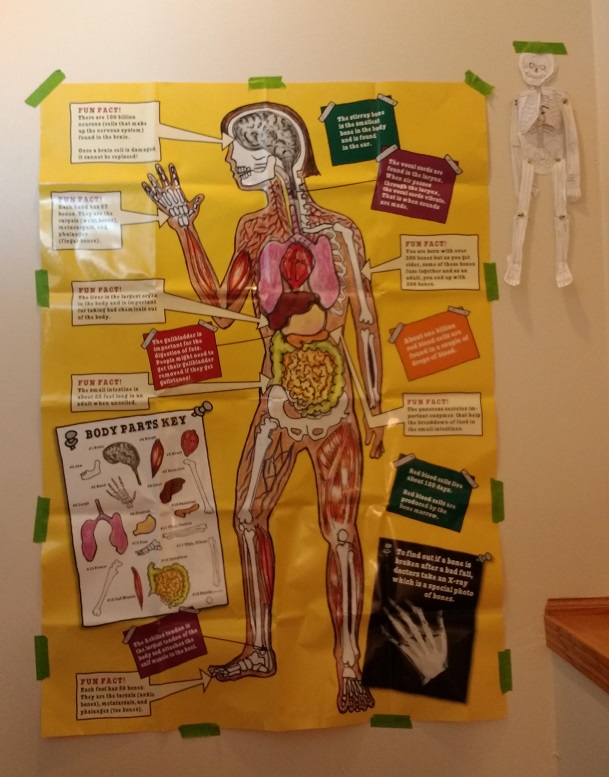
Even though we are done with our school year for the summer, my daughters and I continue working on some science lessons together. One wall in my house displays some of our recent studies of human anatomy and physiology, which we have been studying using Apologia Human Anatomy and Physiology.

The large body poster is from a Magic School Bus kit. The skeleton replica is from The Giant Science Resource Book, which is a resource book I have used over and over again with my daughters for various science lessons. It was definitely worth the $2 I paid for it at a rummage sale! I use painter’s tape when I hang the items so the paint (hopefully) doesn’t peel when the items are removed from the walls.

magic school bus human body poster

My daughters have enjoyed science so much, one of my daughters even decided to have a science themed birthday party one year. (I have really enjoyed throwing inexpensive, yet entertaining themed birthday parties for my daughters!)

During the science themed birthday party, my living room became a science museum, and all of the guests became scientists. We had a lot of fun performing experiments (in my kitchen), exploring the hands-on science museum (my living room), and enjoying a cake decorated as a cell.

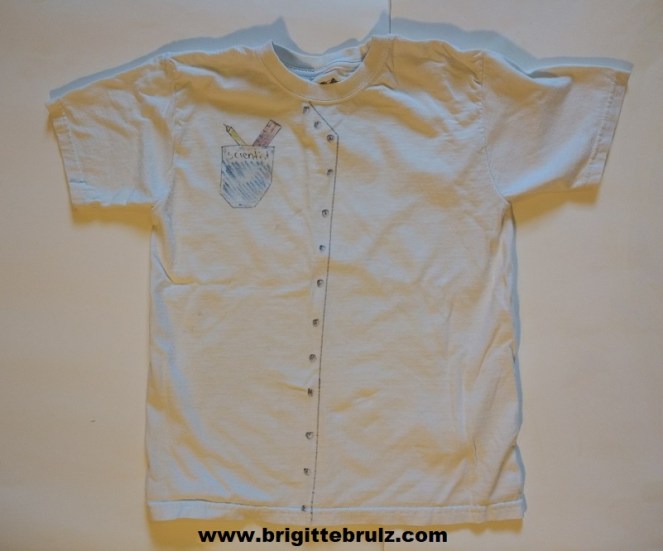
Each of the kids went home with goggles, a test tube filled with candy, a homemade scientist ID badge, and their own scientist shirts I had purchased from The Dollar Tree (only $1 each) and decorated ahead of time.

I saw the idea for this shirt somewhere online years ago, although I can’t remember where I had seen it.

science t-shirt

Another result of our love for science experiments is the number of science kits we have accumulated over the years as gifts from family.

We have enjoyed each of the science kits we have received; however, we would not have nearly as many science kits if they weren’t given as gifts. Some of the kits can be rather pricey especially since most of them still require extra supplies not included to complete the experiments.

For that reason, I have compiled a list of 50 simple science experiments that use basic household supplies, which was recently posted on Hands On As We Grow. No science kit required!

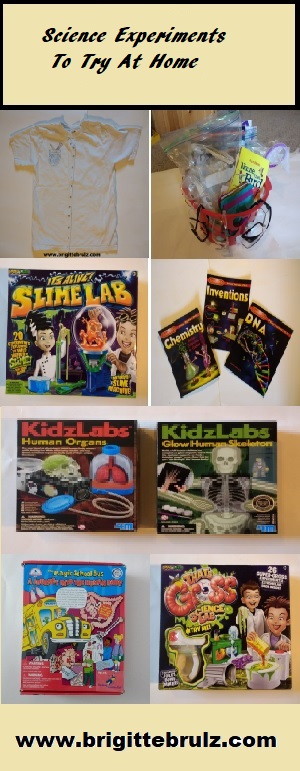
Some of the science kits my daughters currently own and have used are shown below incase you are interested.

Smart Lab: It’s Alive Slime Lab

This one requires batteries and other ingredients that are not included in the kit.

It's Alive Slime Lab science

Smart Lab: That’s Gross Science Lab

I recommend putting a bag around the top part of the toilet in this kit to protect the button from all of the messiness. Again, additional materials are needed to do the experiments in this kit.

That Gross Science Lab

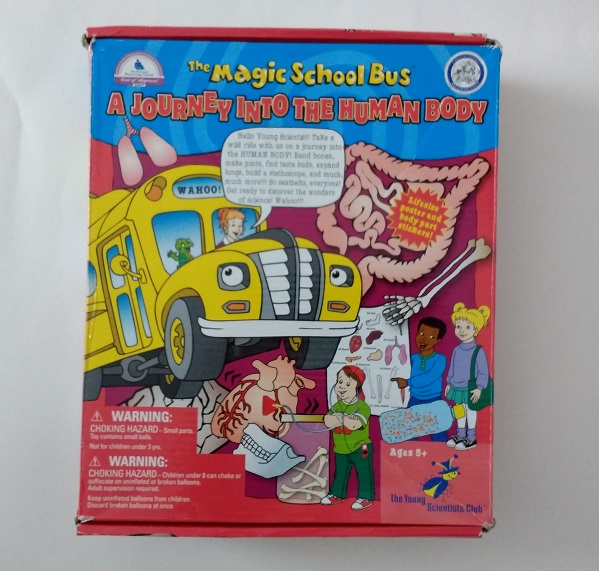
Magic School Bus: A Journey Into the Human Body

This is the kit the poster on our wall came from. My daughters placed the organ stickers that came with the kit on the human body poster as we discussed them.

We ended up with a horrible stench when we attempted Tim’s Experiment #1 described within this kit. Maybe if we had cleaned the chicken bones (not included) better, the stench wouldn’t have been as bad.

Magic School Bus science kit

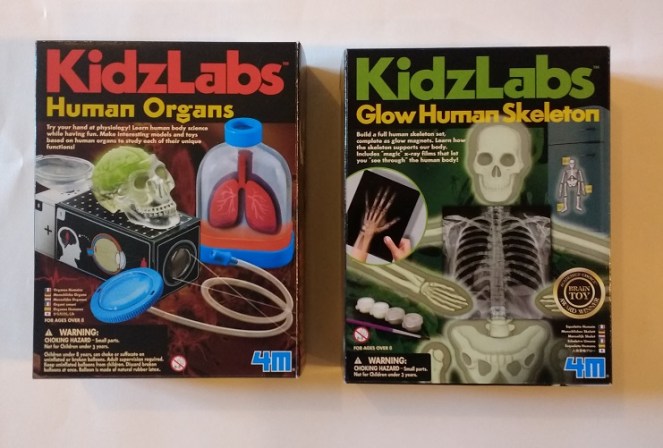
KidzLabs Human Organs and KidzLabs Glow Human Skeleton

You could try to make a fake lung as seen on Science Sparks if you are interested in demonstrating how lungs work and don’t want to spend the money on the human organs kit.

The magnets included in our human skeleton kit were not strong enough to hold up the bones we created with the kit, but it was still fun to build a human skeleton.

KidzLabs science

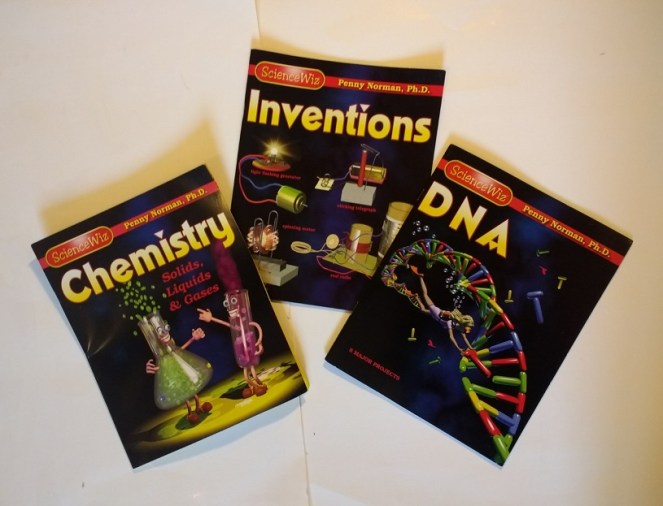
Science Wiz Chemistry and Science Wiz Inventions and Science Wiz DNA

This picture only shows the books that came with the kits, but there are other materials within each kit. The DNA kit was my favorite of these three!

Science Wiz kits

In order to complete each of the science kits my daughters receive, we intentionally schedule our own at-home “science days”. Before the science days, I prepare by reading through the supply lists and gathering all of the needed supplies.

Making mistakes and having experiment failures are part of being a scientist, right? In that case, I’m a great scientist! Experiments definitely don’t always go as planned.

Do you enjoy doing science experiments? Have you had any science experiment mishaps? I would love to hear from you!

Jobs of a Preschooler- I'm a scientist...

“I’m a scientist experimenting…”


Events · Ramblings · Writing Appearances

25 Books About Grandparents

(This post contains affiliate links, which means I may make a small commission at no extra charge to you if you click on a link and make a purchase. As an Amazon Associate, I earn from qualifying purchases. I greatly appreciate all purchases you make using these links. Thank you!)

I have been attending monthly author meetings for quite a few months now. I recently also started going to a monthly picture book meeting where a different topic concerning picture books is discussed each month.

This month, books about grandparents were discussed at the picture book meeting. Who says you have to wait until September to celebrate Grandparents Day?

To prepare for the meeting, I read 14 books (checked out from my local library) about grandparents. I really enjoyed some of them, but others weren’t quite my style. I know that everyone has their own preference of books, so I’ve decided to include all of the grandparent books I read with a brief description of each one. Some of them describe serious topics such as Alzheimer’s while others are rather silly or imaginative.

 Grandma Forgets by Paul Russell

I really liked this book about a granddaughter talking about how her grandma forgets things. Although the word “Alzheimer’s” is never mentioned, this book does portray the effects of Alzheimer’s. It also mentions grandma “lives with people who remember for her”, which seems like a pleasant way to discuss why a grandparent may have to move to a nursing home. Throughout the story, the granddaughter stays positive and helps create new memories with her grandma.

Grandma by Jessica Shepherd

A young boy named Oscar shares his adventures with his grandma. Even on days his grandma doesn’t feel like playing, they are still able to find some activities to do together. Oscar even helps his grandma wash dishes. Grandma starts to forget things, so she has to move to “be with people who know how to help her”. Oscar is nervous the first day he visits her at her new home (a nursing home), but he finds he is still able to have fun while visiting his grandma. The book talks about how Oscar’s grandma sometimes will shout at people or get confused, so Oscar creates a box of happy memories to look at with her.

There are a couple of pages at the end of the book that talk about dementia and what happens as people get older. It includes suggestions on what activities you can do with someone you love who has dementia.

Grandma and Me: A Kid’s Guide for Alzheimer’s & Dementia by Beatrice Tauber Prior, Psy.D. & Mary Ann Drummond, RN

This book is a very long and detailed book about a grandma with Alzheimer’s. It talks about how the grandma may be sad or withdrawn at times, forgets current things, but can still remember some events from long ago. It talks about what Alzheimer’s is. It even goes in depth about what neurons are and how they are not working properly in a person with Alzheimer’s. It also discusses a few therapies or ways to help grandma. At the end of the book, even more information is provided for parents and caregivers to read about how to prepare a young child for the journey a family member may go through with Alzheimer’s.

What Can Your Grandma Do? by Anne Sawan and Sernur Isik

This book is about a class preparing to celebrate Grandparents Appreciation Week by inviting grandparents to come in and share a special talent. As each of the children in the class share what talents his or her grandparents have, one boy seems to think his grandma doesn’t have any special talent. Later, he realizes she does infact have a special  talent.

Every child in the book’s class has a grandparent, which may not be the case for all children in a classroom setting. A few of these grandparents even have quite active talents – ballet, salsa dancing, hula hooping, and slam dunking a basketball.

I Love My Grandma by Giles Andreae

This has simple one to two lines of text on each page, so it would be appropriate for a young child. Most of the text rhymes, but there are a few times when the words don’t such as mine and time, fun and mom, and tummy and funny. It talks about various activities a grandchild does with his grandmother.

Llama Llama Gram and Grandpa by Anna Dewdney

Following the style of the Llama Llama series, this book shows a young llama grandchild who will be spending the night with his grandparents. He has a fun-filled day with his grandparents playing outside, riding a tractor, working in the garden, and more. Unfortunately, little llama has forgotten his fuzzy llama stuffed animal, which he thinks he needs to sleep. Grandpa comes to the rescue with his own special toy to share with little llama.

Grandma’s Purse by Vanessa Brantley-Newton

A young girl looks through her grandma Mimi’s purse with her grandma Mimi. She finds all kinds of items such as lipstick, “smell-good”, hair pins, glasses, and more. As she pulls the items out, her grandma Mimi explains the significance of each of the items. The story ends with the girl finding a special gift at the bottom of the purse for her to keep.

40 Uses For a Grandpa by Harriet Ziefert

This book is a list of 40 uses for a grandpa with pictures to coincide with each numbered item. For example, the first page says: “1. play date”. The book ends with a page that says: “40. friend”.

I Really Want to See You Grandma by Taro Gomi

Very simple text (1-2 lines on each page) tells the story of a grandma and granddaughter who want to see each other, so they set out to visit each other at the same time. As a result of them both being gone at the same time, they keep missing each other. Eventually they meet under a tree, which they decide to use as a future meeting place.

Me Too, Grandma! by Jane Chapman

Grandma has a wonderful surprise for her little owl grandson, Ollie: a new baby cousin owl. Ollie sees that he is no longer the center of attention and becomes a little jealous of his new little cousin and quite sad thinking that his grandma no longer loves him with her whole heart. Grandma owl explains to Ollie that grandmas grow new love for each addition to the family, and no other baby could ever remove any of the love from little Ollie. At the end, Ollie realizes he can have fun with his little cousin, and he still has Grandma Owl’s love.

When a new addition is added to the family, children may feel the same emotions as little Ollie. It’s always comforting for them to know they are still loved and appreciated.

Skyfishing by Gideon Sterer

Grandpa moves from the country to live in the city with his granddaughter’s family. Grandpa really misses fishing, and his granddaughter wants to uplift her sad grandpa. The granddaughter decides to play pretend with her grandpa. Their imaginations lead them to capturing all kinds of city fish: laundry eels (laundry line), Capfish (hats), goldfish (gold necklaces), and more.

Grandma’s Gift by Eric Velasquez

A young boy spends time with his grandma who is originally from Puerto Rico and only knows Spanish, so he translates some things to her that she can’t read or understand. Some Spanish words are used throughout the book with English translations. The boy and his grandma go shopping, gather various ingredients, and spend quite a bit of time making pasteles. They later go to a museum together, where they learn about a man named Juan de Pareja they see in a painting.  At the end of the book, the grandson receives a special gift from his grandma.

How to Babysit a Grandpa by Jean Reagan

This is a silly how-to book from one grandchild to another. In the book, the child talks about what to do when grandpa arrives at the house, what snacks to enjoy, what to do on a walk, how to entertain and play, what to do during his naptime, how to wake him up, and how to say good-bye. There is quite a bit of humor throughout the book such as making sure to put sunscreen on grandpa – “especially the top of his head” with a picture of the grandchild dousing grandpa’s bald head with sunscreen.

How to Babysit a Grandma by Jean Reagan

Similar to How to Babysit a Grandpa, this book goes through the steps of how to babysit a grandma. The grandpa and grandson from How to Babysit a Grandpa make an appearance in a picture at the park in this book. The tips on babysitting a grandma are different from babysitting a grandpa, so there are still humorous (and sweet) results without repeated information.

In addition to the 14 books I had read ahead of time, other books about grandparents were also mentioned at the picture book meeting. Below are 11 of the books we looked through at the meeting, which brings the total to 25 books about grandparents.

Drawn Together by Minh Le 

A young boy and his grandfather speak different languages, so they struggle with communication. Through comic strip type illustrations, the grandfather and grandson learn to communicate by drawing. Most of the story is told through the illustrations, so there are very few words.

Ocean Meets Sky by Terry Fan and Eric Fan

A young boy builds a boat to honor his grandfather who had passed away. The grandson goes on a grand adventure on the boat. At the end, his mom wakes him up from his exciting dream.

A Fire Truck Named Red by Randall de Seve

A young boy wants a brand new fire truck, but his grandpa gives him a fire truck he had as a child instead. The child is disappointed, but his grandfather tells him of some grand adventures he and his fire truck had when he was young. The grandpa spruces up the fire truck for the young boy, and the grandson realizes that he and the fire truck will make a great team (even if it isn’t brand new).

Where’s Halmoni? by Julie Kim

With many more pictures than words, this book shows two children on an imaginative search for their Halmoni (grandmother). They pass a hungry rabbit, goblins, a tiger, and a fox before finally reaching their Halmoni. Korean words are shown throughout the book with English translations at the end.

15 Things Not to Do with a Grandma by Margaret McAllister 

Fifteen random things to not do with a grandma such as “don’t hide an elephant in grandma’s bed” are given. Some things to do with a grandma are mentioned towards the end of the story.

My Grandpa by Marta Altes

A young grandchild bear talks about his grandpa bear getting older and forgetting things, but they still find things they can do together. It has very simple text with only one line on each page.

Rain by Sam Usher

A boy wants to go outside, but his grandpa keeps telling him no because it is raining. The rain finally stops, so the grandchild goes out to mail a letter with his grandpa. As they are outside, it begins to rain again resulting in some imaginative pictures. The grandpa and grandchild end the story with getting warm in the house.

In the Red Canoe by Leslie A. Davidson

A sweet rhyming book about a granddaughter spending time with her grandpa out on a canoe. They enjoy the scenery as they see beavers, fish, ducks, dragonflies, and more.

When We Were Alone by David Alexander Robertson

An inquisitive granddaughter asks her grandma “Nokom” many questions while working together in a garden. Her grandma responds by telling her granddaughter about tough times she endured at a residential school she attended when she was a little girl.

Me and My Grandma! by Alison Ritchie 

A rhyming story about the different activities a grandma bear and her grandchild do together. Grandma bear can even do cartwheels down a hill! Grandma also gives bear hugs “to make everything right”.

Stolen Words by Melanie Florence

A granddaughter asks her grandfather about his Cree language, but he can’t remember the words. The grandfather tells his granddaughter about the struggles he faced while growing up that stole the words from him. The granddaughter finds a book with the Cree language to give to her grandpa so he can remember the words.

Do you have a favorite book about grandparents that I didn’t include here?